Monday, January 16, 2012

Jessica McCambly: "Float" Interview from YouTube


This is an interview by The New Children's Museum with artist, and my friend, Jessica McCambly.  McCambly discusses her latest installation at the museum titled Float.  The overall installation is titled Trash and includes works by twelve artists.  In addition to McCambly's, there are also works by Ed Ruscha and Vic Muniz.

From the New Children's Museum's web page we learn this about Float:
"Finding complexity in simple material, Jessica McCambly transforms ubiquitous white plastic shopping bags into an ephemeral cloud of light and shadow. Created from bags collected from NCM visitors, the accumulated mass of delicate imperfect rings, floats mist-like overhead, mimicking the dynamic shape of a wave breaking against the shore. The uniformity and intricate alteration of material invites myriad associations to be projected onto the suspended formation. McCambly encourages visitors to slow down and observe the temporal shapes the light draws against the wall and to contemplate the quiet beauty in the subtle shifts the piece makes over time. The simple act of noticing is critical to the experience of this work. As McCambly states, “the fast pace and culture of convenience that necessitates these plastic bags is also the one that interferes with our ability to notice fleeting moments of visual, aesthetic pleasure.” By reducing the pace, McCambly offers an alternative, giving us an opportunity to breathe and find the magic in the mundane."

McCambly received her BFA and MFA in Painting and Drawing from the University of North Texas.  I first came to know Jessica when she was a member of the art collective 500X. Jessica has curated an exhibition Big and Bright at Southwestern College, Chula Vista, CA that opens January 26, 2012.  This exhibition includes one of Rusty Scruby's works. 

We visited with Jessica and her artist husband, John Oliver Lewis, last year while in LA.  John helped Rusty hang and light Rusty's gallery exhibition at PYO gallery, for which we are eternally grateful!

John and Jessica at dinner with us after installation and before the opening

I have three of McCambly's works in my collection including this one which reminds me of Float, and she tells me that it was one of the precursors to Float:

Swarm Colony Study 4, 2007
acrylic, powdered mica, sterling silver, cast shadows

Tuesday, January 10, 2012

Lost in the Desert


Today marks the first anniversary of the theft of Rusty Scruby's art work.  Quin Mathews and his crew at QMFILMS has told the story beautifully and I've attached the video above.  Rusty also has the story in his own words on his website. Both of these tellings of the events of January 10, 2011, the day and the week starting with that day, were recorded as soon as we returned home from LA on January 25, 2011.
Rusty's next exhibition was scheduled for March 12, 2011 in Miami at PanAmerican ArtProjects. Rusty had originally planned a new body of work for PanAm, but after the theft he decided to recreate some of the artworks that had been stolen and had never been seen by anyone but me and a few people in the Angel View Thrift Mart. Janda Wetherington, director of PanAmerican ArtProjects, gave Rusty a third 'project' gallery space to tell a visual story of the theft.  This was a cathartic project for Rusty:

Quin Mathews' film was projected on one wall of the PanAm Project gallery

Rusty installed images and recovered but ruined art works on the oppisite walls.


The installation took several days to print all of the images that Rusty then took several days to pin up on the two walls.  He had recovered Thanksgiving but it had a hole punched in it by an unknown source rendering it unsellable. Rusty used this piece and recreated one of the possible scenarios he imagined as the cause of the hole by pushing a broken stretcher frame through the hole to present in the installation. On the adjacent wall, Rusty pinned up dual images, one on top of the other.  The base image is an interior shot of the thrift store.  The outer image is a picture of the Angel View Thrift Mart as seen from across the street.  Rusty employed an oscillating fan on a stand to create wind that caused the outer images to lift and reveal the base image underneath.  This action represented a variety of stream of conscious thoughts. The desert winds eroding objects in the harsh elements. The temporal nature of art once it is released from the studio. The hidden truths of the seemingly shady business conducted at the Angel View Thrift Mart as well as by the many local police and sherrif departments that Rusty had to deal with in Palm Desert, Indio, and Palm Springs.  It also represented Rusty's fears and feeling of loss of control over the situation and his stolen art.
Since the theft, people have repeatedly asked Rusty questions such as "how will this change or inform your work?".  It will take longer than this one year to fully realize an accurate answer to these questions.  Grief over the loss of a loved one or one's work and livelihood can take years to heal, and grief continues to manifest in both positive as well as negative ways. I will say, however, that the work that Rusty created for his December show at Cris Worley Fine Art was a fresh realization of his knitted/woven photographs.  He used circles instead of the hexagons, squares, and rhomboids employed in the works stolen and the works recreated and shown at PanAmerican ArtProjects.  Also, the work at CWFA was not mounted on stretcher frames, instead it hung loosely in the way that tapestries are hung. In addition, Rusty acquired some wool yarn just before Christmas and pulled out all of his knitting needles and began re-exploring various knitting techniques.  He is allowing this process to inform his thoughts and ideas toward realizing fresh concepts and techniques for future works of fine art.

For myself, the theft came on the heals of my losing my job and career of the previous thirty-three years.  This blog has been one of my responses to those losses.  This blog has also been a means for me to stay busy, maintain my pc skills, and expound beyond my technical wirting skills.  Plus it allows me to talk about one of my favorite subjects - contemporary visual art and the people that create it.

Today marks the end of our official mourning period.  Together we are moving forward.  And to end, I use one of my favorite Friedrich Nietzche quotes:
"That which does not kill us makes us stronger."

Tuesday, January 3, 2012

Gun & Knife Show @ Centraltrak, Apr 30 - Jun 4, 2011


Before the 2012 art season kicks into high gear starting this coming weekend, I want to spend a bit of time recalling some of the art exhibits and venues that left an impression on me.  This post reviews
Gun & Knife Show at Centraltrak co-curated by Heyd Fontenot and Julie Webb.

I stopped by Centraltrak on May 6 while the temps in Dallas were still in the low to mid 80°F.  Gun and knife shows are a constant in Dallas, and over most all of Texas. In fact, there were several billboards within blocks of the gallery that advertised different gun and knife shows at several locations around the DFW area during that time period.  But this was an art show and quite different from the other shows, I suspect, though I've never been to the kind that actually sell weaponry.


This exhibition featured works by 40 artists, some local and others from various U.S. cities.  The artists included were:
  Leon Alesi, Sterling Allen, Nick Barbee, Tony Barsotti, Chicks Bill, Camp Bosworth, William S. Burroughs, Louie Cordero, Chris Crites, Jack Daws, Leah DeVun, Margaret Evangeline, Al Farrow, Faith Gay, William Gaynor, Charles Hancock, Bootsy Holler, Donna Huanca, Bruce LaBruce, Jeffrey Lee, Lance Letscher, Dotty Love, Marne Lucas, Margaret Meehan, Katrina Moorhead, Tim Roda, Royal Robertson, Alexandre Rosa, Tom Sale, Joshua Saunders, Brian Scott, Roger Shimomura, Taro-kun, Karlo "Kaloy" Olavides, Dan Phillips, Robert The, Terri Thomas, Bruce Lee Webb, Barnaby Whitfield
Heyd Fontenot had recently become one of the artists in residence at the University of Texas, Dallas Centraltrak and soon became the director of the gallery after this exhibition. Co-curator, Julie Webb, is director and owner of the Webb Gallery in Waxahachie, TX.


These two works by San Fransico/Bay Area artist Al Farrow were probably my favorite two of the whole lot.  The idea of "turning swords into plowshares" is captured in reality as Farrow turns guns and bullets into cathedrals and candelabras. 

Overall, the forty artists employed as many media to create objects and images that ranged from humor to violence.  Some created weapons, while others created works that reflected the results of violent acts.  Lance Letscher presented an actual AK-47 that he covered in a collage of stickers or stamps.  Margaret Meehan created a gun shaped object with butterfly wings out of ceramic and graphite. Brian Scott displayed his apes with guns paintings, but I also saw a dildo gun object that I think was his creation also.  Many different works that shared a common theme of some type of weaponry fetish as art.


Some works were on pedestals as in a usual white walled gallery.  But other objects and works on paper were in acrylic cases, while others that hung on the wall were placed within painted frames that gave me the feeling of vertical showcases.  Overall, the show had the feel of a trunk show or trade fair as I image real gun and knife shows are displayed.  But these works of art went much deeper in meaning than their more violent counterparts.  I was a bit surprised that a group show with this many artists actually worked, the theme carried through and I was both attracted and repelled simultaneously.


This one installation commanded its own corner wall to display the visceral effects of silver objects pummeled with bullets.

I received guns for Christmas for many years as a kid.  I let my dad lock them in his gun safe after I unwrapped them.  Hopefully some of them will have great value someday when I carry them into an Antiques Roadshow appraisal.  Meanwhile, this Gun & Knife Show is as close to the real thing as I care to go.  But I am still thinking about this one.

Tuesday, December 27, 2011

The Wedding Project (The Wedding of Ben + Carolyn)


I'm taking some time as 2011 winds down and the new year of 2012 begins to recall some of my favorite art of 2011 that I have not already posted.  In September, Rusty and I answered an open call from our friend Carolyn Sortor to participate in her wedding project.  We choose to be Ministers of Guidance which translates as 'ushers' in more traditional weddings.  Naturally, I took my camera to document my point of view.  I am very honored that Carolyn has chosen to use some of my photos, among many others, as documenation of the event on her website.  See photos on her website through this link.  I've been receiving visitors to my blog via Carolyn's website, www.c-cyte.com, and so I thank her for that!

me and Rusty at The Wedding Project, September 17, 2011
my camera, but photo taken by professional photographer Carolyn McGovern McWeeney

No, Rusty and I did not get married also.  You can clearly see the Dallas skyline in the background with the new Calatrava bridge under construction to the left of me, so you know this was certainly not a gay wedding! All participants and all guests were asked to wear white, extra points for an ill fitting wedding dress, so that video could be easily projected on all in attendance which was also being recorded on video. While we didn't get married, all guests were requested to kiss each other at the point in the ceremony when the minister invited the newly wedded couple to kiss each other.  Carolyn McGovern McWeeney did capture a pic of me and Rusty kissing with her camera before the festivities began.  That photo is in catalog on c-cyte.


One gentleman in his 'ill fitting' wedding dress.


First duty as Ministers of Guidance was to direct guests to the veiling station where everyone was given a veil to wear.


After veils were in place, we directed the guests to stand in the area defined by a projected grid.  Once the ceremony began, video was projected on the screen behind the minister (seen in the middle background) as well as on the backs of the guests.  Video cameras were then recording all of the proceedings. 


Above: the bride dressed in black sits while reviewing project plans with one of the cameramen prior to the ceremony.

Carolyn quotes Andy Warhol for the beginning text on her More About the Wedding Project page, "I don't know where the artificial stops and the real starts."  Appropriate for any wedding ceremony, really, IMHO.

We didn't make it to the reception afterwards.  Frankly, we missed the info on the mailed announcement plus it was time to get our 'early bird' selves back to the studio once the wedding ceremony was over.  Continue to check in at Carolyn's website www.c-cyte.com for updates, more pictures, guest comments, and someday soon, the final edited video of the BEST ART WEDDING of 2011!


Thursday, December 22, 2011

Hadar Sobol: "Go" at McKinney Avenue Contemporary


This exhibition ended on December 10, and I had seen it a month earlier.  But oddly enough, it is stuck in my mind. Odd, because this is not the type of work that usually appeals to this 50-something gay guy - and some video, no less, that I usually never even notice.

Hadar Sobol was born in Israel and earned her Bachelor degree at The Israeli University for Fashion and Textile Design.  She was quite pregnant during the creation of some of these works, and still very much so on the day I stopped by The MAC to see the galleries.  The director of the gallery asked me to wait a bit before viewing the show while Sobol made some minor adjustments.

So I went through the Robert Polidori exhibit and viewed large photos of the restoration of the royal palace of Versailles.  Next I gazed upon very large charcoal drawings on paper by James Drake and this one sculpture:

James Drake, Snakeskin Engine, motorcycle engine, python snakeskin, 1994

I have no idea how this one sculpture that was sixteen years older than Drake's newest drawing related to the drawings, but it did resonate, at least to me, with Sobol's work that I moved toward next.  As I stated earlier, it is unusual that I am still considering this work.  But since it is the first day of winter, and the third night of Hanukkah, and two days before I will be celebrating another pregnant Israeli woman's gift to the world, I am documenting Sobol's works and my thoughts about it.


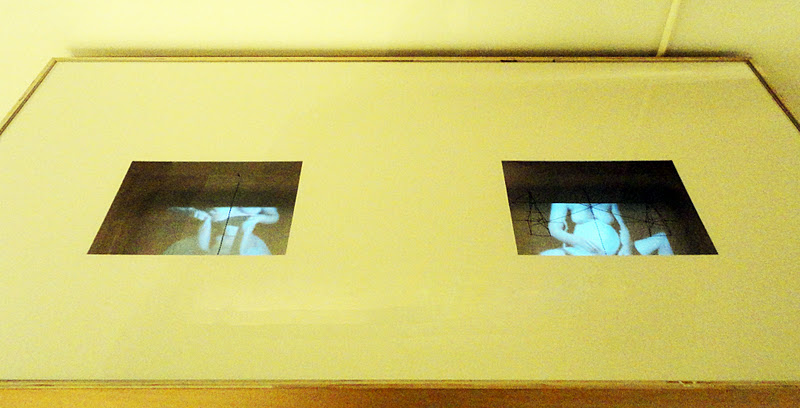
The first thing I noticed was a rather permanent looking, though temporary wall, that created a long narrow entry way.  Two light tables with short loop videos were playing beneath a thin veil of embroidered cloth.  More embroidery hung along the walls, and several of these were hung on top of small lines of LED lights that caused the cloth to radiate a warm glow.  The wall helped me to feel a new sense of being in the small New Works Space in which I had seen a show earlier in the year that felt more like a day spa lobby.  Sobol's exhibition was decidedly different, more intimate, more of a story. 

Another difference of this exhibition was that while there was a page long artist's statement available, there was no list of titles of works, or dimensions, media, or dates created.  There were no wall plaques, either, except for this:


And "the work to the right" mentioned refers to this massive wall sized hand stitched labyrinth:


We have a labyrinth at church.  I understand a labyrinth to be a sacred space, a tool to pray and meditate, and as a metaphor for a life's journey or a journey into one's deepest self.  For some reason labyrinths feel feminine to me.  Perhaps it is the curves, or the non-linear approach to a journey, or maybe it is my association with the first four letters of the word.  But in this case we are told that this work was created by a gathering of 20 women.  We see stitched figures moving around the labyrinth in an overall "X" pattern.  Upon closer inspection we find interesting text stitched into the fabric.


A beautiful massive work created by a community of women in relation with each other for at least as long as it took to make this.  So there is part of the key to why I keep thinking about this work - community and relationships.  But then there is this that I can't stop thinking about:


My gay self keeps screaming that I should be repulsed by this.  Strangely I'm not.  Is it the iridescent threads that glitter?  I do love shiny sparkly things.  Sobol has displayed this work beautifully.  The cloth rests in a valley created by the way the table is constructed.  We see this as a vessel for receiving that which will eventually cause the same vessel to bring forth new life.  What is the sparkle?  Post coital secretions - his, hers?  Perspiration as the labor begins to expel the living contents? Layers of meaning and context via simple shiny threads.  Indeed!

And then this:


Mine's not a great video - shouldn't be, it's just my documentation.  Sobol has the original and it should be seen. But mine provides a visual reference.  We see a very pregnant women seemingly quite capable of providing amble nourishment for her imminent offspring.  We view the video under an embroidered linen.  The video is a very short loop and the action is simple.  She seems to be gathering thread and then stitching it into place on a line in the linen in front of the video.  The action is repetitive just as sewing and embroidery are.  Just as the actions of our daily lives are that eventually accumulate into the journey of our lives.

Sobol said this in her artist's statement: "My other source of inspiration involves both the visual and spiritual idea of the Torah Wimples (a cloth used to bind the Torah during a bar/bat mitzvah and a cloth used to swaddle a baby boy during his circumcision). I was fascinated by the symbolic way it provides an opportunity for a mother to connect her baby with the family, the community, and the Jewish nation.  My intent was to embrace part of this tradition and create for my daughters a personal and unique version of the wimple as a way to pass on a woman's legacy; insight and wisdom gathered by life experience through generations."

I've only attended one bat mitzvah in my life.  My third grade Catechism class loaded up on a Saturday morning for a "multicultural experience", probably while they thought we were too young to jump ship.  But I still remember the experience.  Temple Emmanuel is a gorgeous synagogue in Central Dallas.  I still think about that time as I drive by.  Temple Emmanuel is next to the cemetery where my first partner, Dennis, is buried.  I have a wonderful view from his grave through the trees of Neiman Marcus at NorthPark Mall.

I thank you, Hadar Sobol, for sharing your journey through your art.  You've given this gay goy much to think about. Shalom

Hadar Sobol is represented by Valley House Gallery in Dallas.  Her next exhibition opens January 27, 2012 at Ein Harod Museum of Art, Israel


The 'Art' of Blogging


There are some idiosyncrasies to Blogger that confound me.  I had written the first draft of text for my previous post in an email.  When I was ready to write the post, I was using my netbook without a word processing app so I edited in the original draft email.  I then copied the text from the email to the post I was writing here on Blogger.  I could not make the font in the post match the font in all of my other posts.  Once I was back home, I tried in vain to change the font.  I copied the text out to Word, made note of the fonts and size, and then copied back to the blog.  No luck.  I was being driven to a level of distraction that became quite unproductive.  I finally came to the conclusion that the only solution to matching the font was to retype the text in Blogger on my home pc.  But I know that I would have to be cautious to use new lines to avoid picking up font instructions that may still be imbedded which also means that I would probably have to delete some pictures and then add them back in. Basically, start from scratch!  Finally, I decided to live with it the way it is and move on.
So if the different font in that one post annoys you, know that it did me as well, but then I let go and moved on.  
Enjoy! 


Monday, December 19, 2011

Rusty Scruby: "Memory Bytes" at Cris Worley Fine Arts

Self Portrait, photo reconstruction, 2011

Photography has allowed the average person to capture moments of their lives to hold as souvenirs or markers of important events. Some photos are intended to simply document a moment in time or the image of a loved one or even ones self. The understood application of capturing these images is to enable one to reconnect with that memory at a later date in time. The photographs are stored in albums, scrapbooks or digital files for future reference. This common practice of image capture, filing, and later recovery sets up the dynamic for Rusty Scruby's latest exhibition "Memory Bytes" at Cris Worley Fine Arts.


Scruby delves into his family photo album once again to create new works that challenge the viewer to consider the loss and recovery of visual information. Prevalent thought claims that traditional photographs accurately depict reality. However, photographers such as Susan Sontag argue that a photograph fails to capture enough information about its subject to fully represent reality. Scruby takes Sontag's thought a step further as he utilizes processes which subtract visual details from the original photos.

 Dad - River, photo reconstruction, 2011

Learning to Fish, photo reconstruction, 2011

Scruby does not attempt to present straight forward photographs. Rather, his images take a backseat to the mathematical and musical concepts he is portraying with each work. He chooses images that have a universal commonality, such as family members out for a day at the river and photos from school yearbooks. In doing so, he opens discussion regarding at what point is an image recognizable, to a degree, without being a literal representation.

Dock Instalation detail

In "Memory Bytes" Scruby plays with the full range of scale that he has created to dissect these ideas. In "Dock Installation" Scruby utilizes specific selected sections of an in-focus photograph of a boat dock on the island of Kwajalein. The viewer can see the recognizable elements of the original photo - the horizon line, boats, the silhouettes of two people, and clouds - while the majority of the clouds and sparkling waves have been lost only to be recovered by the viewers subconscious.

Diver, photo reconstruction, 2011

Scruby works the other end of the spectrum in "Diver". The original photo has been reduced to pixels approximating the average color for each facet that he then painstakingly handcuts and subsequently reassembles using his own simulated knitting process. The colors of the mid twentieth century objects reverberate in the hexs and circles that dominate the surface of the piece.

 Mom, photo reconstruction, 2011

Dad, photo reconstruction, 2011

The same process rings true in pieces such as "Dad" and "Mom" even though the colors used in these works is only a range of sepia tones. 

 Red Blouse with White Flowers, photo reconstruction, 2011

Lisa, photo reconstruction, 2011

Again, the viewer confronting "Red Blouse with White Flowers" or "Lisa" is left to their own devices to recover enough visual information to discern the image, which in turn sets up multiple paths of information recovery in the viewer's mind. The viewer may begin to believe that the original image was pulled from their own family album.

Touch, photo reconstruction, 2011

"Memory Bytes" is on view at Cris Worley Fine Arts throught December 21.