Saturday, September 10, 2011

Interview with Cris Worley to celebrate the first anniversary of Cris Worley Fine Arts


I wanted to prepare a story to celebrate Cris Worley Fine Arts' first anniversary. So I met Cris at the gallery.  My eyes enjoyed playing across the colorful canvases of Ruben Nieto’s solo exhibition around us as we spoke: 


HC: Thanks for sitting down for an interview with me today, and congratulations on your first anniversary of having your own gallery.
CW: Thank you, thank you so much.  I’m so excited to be able to say I’m having my first anniversary.
HC: Well yeah!
CW: It’s great to be back in the saddle with my colleagues in the community.
HC: What led you to open your own gallery?
CW: After we closed PanAmerican ArtProjects Dallas at the end of 2009, I decided to start doing some consulting. So I started Cris Worley Fine Arts initially as an art consultant and advisory firm. I worked with individual clients and collectors with their individual needs. That was great. I loved doing that.  It is one of my favorite parts of my work – working with the collector. But at the same time, I really missed having that daily interaction with the artists.  I was still in close contact with several of the artists that I had been working with in the past, and I felt like I wanted to provide a forum for them to show their work because at the end of the day that’s what it’s about.  Having a gallery and having a face to the world. I love being able to point to the work and say ‘let me show you what’s it all about’ (she said smiling happily). 
CW: I’ve always enjoyed being a catalyst between the collector, or enthusiast, curator or the critic, what-have-you – and the artist. It’s very exciting to be a biographer, in a way, and tell the story of the artists and their art. I’m an Art Historian by education, and there will always be a bit of Art Historian inside me that sees the bigger picture.

at the grand opening of the gallery, September 2010

HC: So, here’s a personal business question….(she nods, I proceed) How has business been during this first year, which also happens to be one of the worst years in the US economy?
CW: That’s a good question, and I’m really pleased to say that it’s been extremely successful…better than I could have ever imagined. It’s not just monetary, but of course that plays a role because we have to keep the doors open (she smiles) and I’m grateful for the support I’ve had from the local community – be it collectors or all the other players at large. We really are a unit, we’re a group, and you know – facebook, and blogs such as this, all play a huge role in the success of the gallery’s business. So success is measured in so many different ways. There’s been a lot of good energy around this whole thing. It’s interesting – timing is everything. There’ve been earlier times in my life when it was a seedling idea to open a gallery space, but the timing wasn’t right. I have a lot of years of experience now behind me, over a decade, and you just kinda know when you’re ready. Things just align, and the alignment was there and so I just took a deep breath and jumped ‘out of the airplane’, and so far I’ve had a nice soft landing.

Cris Worley Fine Arts inaugural exhibition
 George Quartz, Maysey Craddock, and Rusty Scruby

 William Cannings

 Murielle White

 Isabelle Du Toit and Elliott Johnson
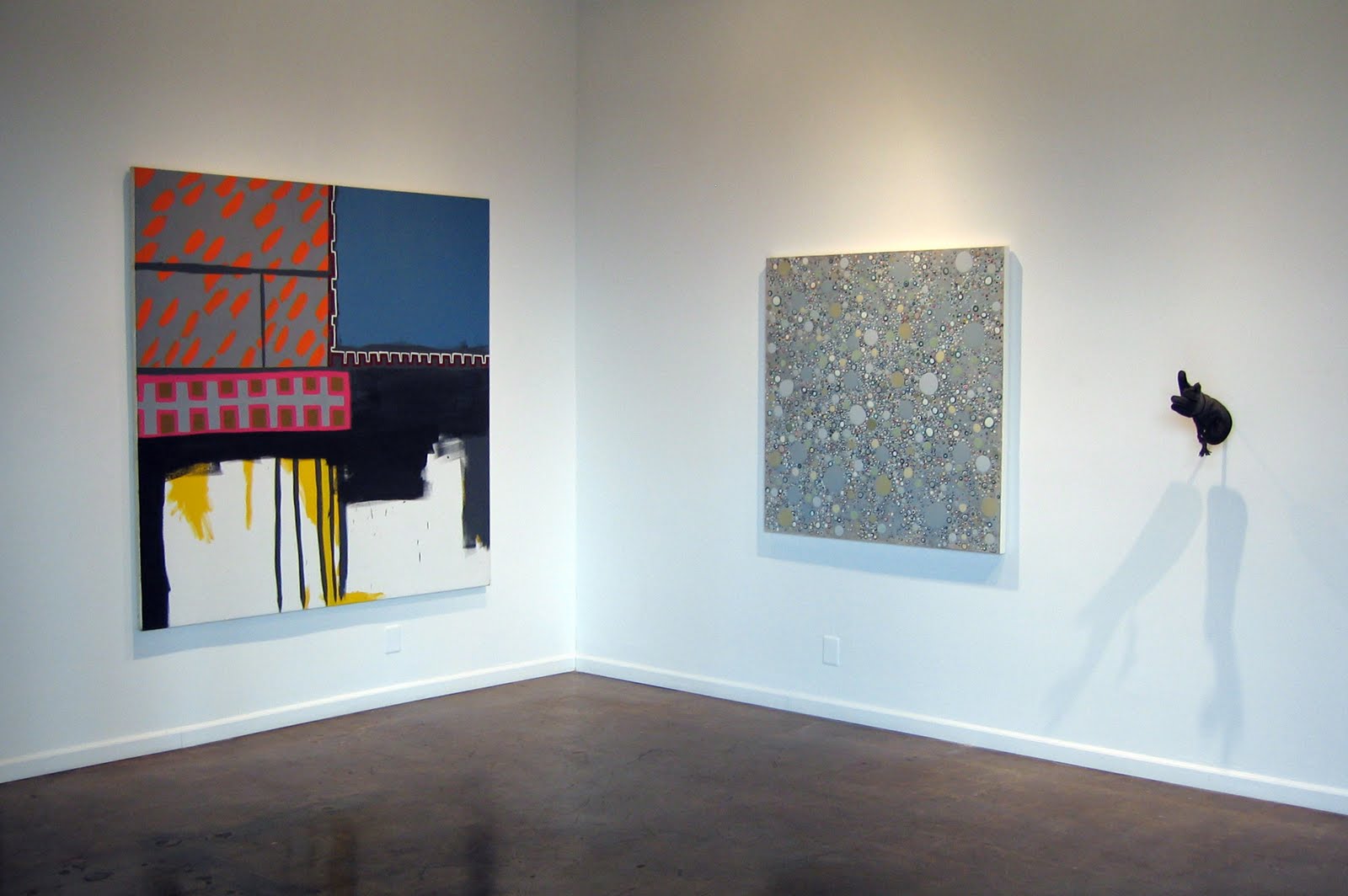
 Ludwig Schwarz, Charlotte Smith, and George Quartz

HC: Excellent.  You have an outstanding program of artists, my bias of course being for Rusty Scruby…
CW: of course (she gives me a wide grin)
HC: I am also very excited to see you exhibiting some of Harry Geffert’s bronze works. Do you have any plans to expand or rework your current programming?

Harry Geffert

CW: Yeah, and I don’t want to give too much away.  In terms of growth, I’ve kept the gallery small and it will continue to be small in size, but I don’t think it will be small in programming. As always, I look at a lot of artists work.  I do a lot of studio visits. I talk to a lot of people and I keep my eyes and ears open.  In that way there will always be expansion. If you want to talk nuts and bolts, I did a lot of group shows in my first year, and those will now parlay into more focused solo shows for the group of artists that I am working with. For the fall there is a really nice concentration of three artists, including Rusty Scruby in November and December, and Harry Geffert in October, and Charlotte Smith in September to kick off the Fall Gallery Walk.  Art fairs are always something that is a consideration.  In terms of expansion, another thing that I’m interested in is education in the programming.  And that may, at first, end up being a collaborative effort with the Contemporary Art Dealers of Dallas.
HC: And congratulations for becoming a new member of CADD.
CW: Yes, thank you. I was one of the charter members of CADD when I was under the blanket of PanAmerican ArtProjects Dallas. Being a part of the entity, I felt a lot of nurturing toward its creation and early growth.  And so I felt happy to be invited back, by my colleagues, as my own gallery. So thank you.

Cris Worley Fine Arts at the Dallas Art Fair January 2011
William Cannings' sculpture in front

HC: You just mentioned your experience with art fairs, and you participated in the Dallas Art Fair as Cris Worley Fine Arts this past January.  How would you compare your experience with the Dallas Art Fair with your past experience at art fairs outside of Dallas?

me visiting Cris in the PanAmerican ArtProjects booth
at Red Dot Fair Miami, 2007

CW: Well, doing an art fair in your own home town is like an extension of your own gallery and your own gallery openings, and it just feels really good. When you go out of town, and you are setting up shop so to speak, in these foreign countries, or in cities where you’re having to maneuver – which I mean, it can be great, there is a lot of excitement but also extreme uncertainty. It’s great to meet new people, did that too here in Dallas.  And that was also one of the wonderful things about doing the Dallas Art Fair - being in the larger context of the Dallas Art Fair, I met so many new wonderful, enthusiastic and cool people. But, you know, when you’re in another country or in a city other than your own, you’re supporting artists that people may or may not have ever heard of.  You have to expect a bit of a learning curve for people. You just expect that will become a relationship building that will evolve over time. In fact, this whole business is about evolving relationships.
HC: What’s on the horizon for Cris Worley Fine Arts?
CW: I am very interested in working with emerging, innovative, forward thinking artists, but I’m also interested in working with what I call the veteran artists who maybe value a different approach.  I also, at the same time, am interested in new methodologies, new ideas, new media in art, but I’m also extremely focused on technique and skill, and a bit of formalism. So you will continue to see those kind of things evolve here.  I think, for a large part, it will be up to the artists as well. So I’m really excited to continue a relationship with them. You know, the work is always the end result.  I am very honored to be a witness to the process of seeing a body of work come into existence.
HC: So to wrap up, you’ve got Charlotte Smith opening the season in September, followed by Harry Geffert in October into November and then Rusty Scruby closing out 2011….
CW: Yes, and then I have Paul Manes, Maysey Craddock and Murielle White for the spring time periods. I’m still working on January, I have several ideas I am considering.

Cris Worley Fine Arts first show for the 2011/2012 art season opens tonight with new works by Charlotte Smith. A catalog has been published with an essay by Catherine D. Anspon.


Thursday, September 8, 2011

Interview with Simeen Farhat

Insceced, cast resin, 2011
photo used with permission from Simeen Farhat

I went to visit Simeen Farhat in her large apartment/studio.  She lives in one of those now-rare-in-Dallas early 20th century four-plex apartments that have high ceilings and reach far back into the lot providing for a number of large rooms.  Like most artists, her works in process were present from the front door to the back.  She was preparing for multiple upcoming exhibits both in Texas and abroad.
.
Simeen in one of the rooms of her studio

Simeen started off by showing me around each room in which she performs her various processes separately.  In the room pictured above, she cuts the word or phrase shapes out of MDF and then creates latex molds.  She has molds for each word or small phrase for many of the different cluster sculpture and installations that she creates.  She pours resin in the molds in another room and allows them to set up in various rooms.  She also showed me a small pressure chamber that she uses to set the crystal and translucent resins which helps them retain clarity rather than becoming too cloudy.

detail of one element "most"

Simeen has been sculpting using painted wood forming words and phrases in Urdu.  She creates her own stylized fonts, though many of us in the States have not been able to pick out the words we see represented in her stylized Arabic script.  For her exhibitions at Anya Tish Gallery and Kirk Hopper Fine Art, Simeen has started to use English translations.  The picture above shows one of the word elements that she later combined into a cluster sculpture.  The word "most" is shown above in her own stylized font - see the "m" moving from the far left to the far right; the "o" and "s" overlap the middle bottom of the "m", and the "t" sticks up above the "m" as it rises out of the "o".  For these two exhibitions, Simeen has chosen Edward Fitzgerald's English translations of Omar Khayyam's poetry. 

Morphed, cast resin, 2011
photo used with permission from Simeen Farhat 

The translucent resin has allowed Simeen to add extra layers of conceptual meaning to her works.  The dark rich brown color of the elements in Morphed shown above call to mind both the henna dyes that women of the Sub-Continent adorn their skin as well as the glass bottles of Shiner Beer.  We see both sides of Simeen's past and present cultures coming together.  She also showed me icy blue resin pieces and smokey gray works as seen in "most" above.  Anya Tish's press release tells us this about the exhibition and Simeen's work:
"Anya Tish Gallery is pleased to announce the opening of Word, Object, Motion, an exhibition of contemporary Islamic art, featuring the work of Dallas-based Pakistani artist Simeen Farhat, and Houston-based Iraqi artist Mohammed Al Shammarey. Both artists take inspiration from classical Persian and Urdu poetry, dealing with subjects of human struggle and emotions, freedom of thought and expression. Farhat’s sculptures, created from wood and/or cast resin, explode from the wall, forming three-dimensional manifestations of Urdu and Farsi poems. The sculptures’ compositions, sinuous Pashto calligraphy, present the viewer with many layers of meaning. The shadows cast by the intricately layered forms, bring to mind whispers, as if the words that cast them have just been spoken. Farhat’s work, both original and visually striking in execution, provides a fascinating commentary on present-day perceptions of Islamic culture."

 3 sculptures in her 2008 MAC exhibition
front Shroud of Silence
back left Body Language
back right We Won't Kill You (installation)
photo used with permission from Simeen Farhat

HC: How are your new works different from the exhibition you had at the McKinney Avenue Contemporary in September 2008?
SF: The MAC show was more political. This one is less so, and I want to see how people react. I call these speech bubbles, in a way, because they are like the bubble 'pops'. They are not my words, of course - I'm not a poet yet, maybe I don't want to do poetry - I'm a visual person.
HC: right, visual poetry
SF: this is visual. What I do is poetic dynamism into visual energy.
HC: ah, that is beautiful
SF: that's how I describe my work. It's not that you go read it right there, don't go try to read it. I mean, I will provide the reference and you can go read it. These are like music. When you hear a song, you know, there is poetry there, but what you're really attracted to, especially if it is very melodic and all, is the music, the sound of the lyrics.
HC: right
SF: and even some people reciting sounds so beautiful. You know if you just read something (she shrugs) but with some people even the reciting is so beautiful and it is really appealing. And from where I come, poetry and even philosophy also, and all the poets I use are philosophers, they're talking about life and all these things, and they are timeless. So I am also looking for some contemporary <music and poetry> that is timeless with a lot of philosophy. What I'm trying to get at also is questioning all these things happening in the world. That's how I started it out. In a way, questioning my own culture that I come from. And why is there all this chaos in the world. We are all just human beings, accept the differences and similarities, and be more open to other cultures. And why Sufi, I mean, Sufism had been part of the Islamic culture, and it was very passionate and loving and talking about humanity as opposed to what we see in YaNabi Islam.


Expulsion, fabric, painted-wood, wire, 2009, variable dimensions
photo used with permission from Simeen Farhat

HC: Your 2008 show at the MAC, as you said, was a bit more politically driven, but now you're moving into aspects of life and finding commonalities and relationships between the different peoples and how we're not that different.
SF: yeah, and now the work is becoming less political, it's still political in a way, but the political aspect has become less drastic, it has become more subtle. I mean, it's still there, and I'm making the smoke, I reference it to a lot of things happening, you know, like wild fires or mushroom clouds or something. Now it is more about humanity, like us being who we are, you know these kind of questions. And of course it's visual art. I'm not a politician or a diplomat, you know, I mean I can be a diplomat in the sense of artistic diplomacy. So enjoy it visually.

Smoldering, cast resin, 2011
photo used with permission from Simeen Farhat

HC: So you're going to have a piece up in a project space at Kirk Hopper Fine Art starting September 3 with opening reception on September 10th. And you're in a two person show at Anya Tish Gallery in Houston starting September 9th, the reception is that night also. And then you've got a solo show coming up at La Fontaine Centre of Contemporary Art in Bahrain...
SF: yeah, that show was supposed to be in March, but it got postponed because two weeks before the show was supposed to open, then all this revolution things started up there so it got postponed. Now it opens October 28th. Then I'm also in Abu Dhabi Art Fair and then Contemporary Istanbul art fair.
HC: Is someone taking your work to these art fairs, a gallery, or are you presenting in some type of artist project?
SF: XVA Dubai gallery is taking my work. My gallery in London, Xerxes Art, took my work last year, but they aren't participating this year. I had a solo show at Xerxes last year, too.


one of the works that exhibited in her solo show at Twelve Gates Art Gallery, Philadelphia PA, March 4 - April 30, 2011
photo used with permission from Simeen Farhat

HC: What is your greatest challenge with exhibiting your work outside of the US?
SF: One of the challenges for my art and these shows - shipping.  To make sure everything....especially with my work, oh my god, so that is one reason why also I switched from wood to these resin because they are more durable. They are more archival, and more professional, you know.  They're more forgiving, but also they are more playful to work.  I've been doing a lot of experimenting. I put them in the microwave, I do a lot of these things or maybe use a heat gun, and maybe getting all these twist shapes so they actually are giving me more flexibility.
SF: Since the show at the MAC two years ago, I haven't shown much locally.  I had a two person show at Anya Tish last year with Paul Booker.
HC: Oh, I bet your works looked good together.
SF:  yeah. Anya was perhaps the first gallery in Texas, like main stream galleries, who, you know, believed in my work.  And now Lillian at Kirk Hopper Fine Art is taking the chance and showing my work.

After my studio visit we went and ate at a Vietnamese Buffet a few blocks away.  She continued to tell me the history of Pakistan.  We compared similarities we find in the Muslim faith practice to those of Catholics and other Evangelical Christians - such as fasting for a month once a year, male only clerics, priests, and ministers, oppression of gays and other lesser societal roles for women in general.  I told Simeen that I find her to be a very brave woman and artist and I highly respect her art's message. Simeen has taken a leave from teaching at the University of Texas Arlington to afford her time to make art and to accommodate her extensive travel schedule from this fall into early spring 2012. Simeen is also scheduled to have a solo exhibition this fall at Art Chowk Gallery in her hometown of Karachi, Pakistan.

Sunday, September 4, 2011

Interview with Russ Havard

Russ Havard, Central Park West, watercolor, wood, mixed media, 2011
photo used with permission of Russ Havard

I drove down to Lufkin, Texas to meet and talk to Russ Havard. I’ve admired his work for a number of years having first seen it in New American Paintings #48, 2003. I saw Havard’s work in person for the first time back when Vance Wingate had his own gallery, Gray Matters. Russ was in the final stages of preparing for his exhibit at George Billis Gallery NYC. One sculpture was hanging on the wall to be photographed, three more were on the painting table, as were several of the small “Full of Days” series of framed watercolors.


In listening to Russ tell me about his life’s struggle with Chronic Fatigue Syndrom, I came to realize exactly why I admire his work.  He packs a lot of physical process as well as spiritual and emotional content into every diminutive painting and wall sculpture.  Here then is some of our conversation.

A Walk in the Park, watercolor, wood, mixed media, 2011
photo used with permission of Russ Havard

HC: Will your show at George Billis Gallery NY be the same work or different than your show with his gallery in LA earlier this year?
RH:  Basically the same, both have images of cityscapes, except I used images of LA for that show and I'm using New York scenes for the upcoming show.

Full of Days #15, watercolor with frame, 2011
photo used with permission of Russ Havard

HC: I want to ask you about this work.  As I was looking around your house and studio and I see these small watercolors in small frames, and while I didn't recognize individual works, I do recognize these as similar to or relating to the exhibit you had at the East Texas Museum, all really small works in frames
RH: yeah, yeah
HC: so talk to me about the relationship between these watercolor on paper and the meditation drawings to this other, what I'm more familiar with, more sculptural works.  What are the similarities or differences, the yin and the yang, between those two lines of work?
RH: well I think a lot of it came about because of my physical issues that I was having with the auto immune deal it is based on.  When I got out of grad school, I was laying in bed for a month or so, didn't know what I was going to do, so I bought a watercolor set and started working a little bit.  When I first got out of grad school I was working at a frame shop, she (the owner) was throwing out all the left over frame stock.  'Course what I was supposed to be throwing into the dumpster, I was throwing into the back of my truck.
HC: of course, because that's what artist do

Full of Days #18, watercolor with frame, 2011
photo used with permission of Russ Havard

RH: I figured I could do something with it.  So the first one I made was about this size (he held up the small framed piece shown above that is about 3" square with the frame).  She saw it and said I'll give you some more frame stock and you can make some more.  So that began happening, then I had that relapse, and I made a number of these and they just kept growing in numbers....10, 20, 30...and it was a way to stay in contact with the work - even if I could only work about 5 minutes at a time, you know. The medium of water color you don't have to wait a long time for it to dry, it's pretty immediate, and it has that whole delicacy thing going on, slowly they started becoming taller like the 1 inch x 4 foot that’s in the other room.  I got somewhat better and I moved to Houston.  I started thinking, in this format – thin but long format – I started thinking what would that look like if it were coming off the wall and you could see different sides of it.  That’s really where the thought came from.  So the first ones were rectangular little boxes that came off the wall, kinda like little open books, sort of, that hung on the wall.  That continued to evolve.  I bought a band saw and started making curves.  And that’s how all that got started and then I got into New American Paintings.  Then the sculptural works started to take on a life of their own and didn’t relate as directly to the small frame works.
HC: When I looked at the images for your East Texas Museum show with all those little-bitty frames I thought it was an installation, and they seemed like little sculptures on the wall.  Of course, I knew how you work this other way, too.
RH: well, that’s the whole thing.  There were about 7 or 8 years where I was really just making the sculptures.  I came back to Lufkin to get ready for the museum show.  It’s really a big space, kinda surprising for a small town museum.  I only had a couple of months and it takes a long time to make the sculpture pieces, especially the larger ones.  I moved back from Austin.  I was beat, I was tired, the fatigue was setting in again, and um, my little boxing reference, I kinda make it like Mohammed Ali and rest on the ropes, take a little break, that's his little technique for staying in there.  And I said well I’m going to kinda revive these little framed paintings.  I hadn’t done them in a while, and it’s East Texas, where I come from and all that.  I was able to fill up a whole wall in a short amount of time.  I did 40 of them, based on the 40 days and nights in the wilderness, like trials basically.  If you ever notice the trees are always kinda scraggly…
HC: yeah, I have noticed that

Full of Days #8, watercolor with frame, 2011
photo used with permission of Russ Havard

RH: It wasn’t on purpose for years.  You know, it kinda took me a while to figure that out. I think it all has to do with health issues and all that.  Ever since grad school, I’ve been happier working in multiple media.  The process of cutting the wood is in a different building, it’s a whole different thing – clamps, wood, out in the shop with my dad...working someplace since I was five.  You know, I don’t even think about art out there.  The focus whenever I’m in here is... you become extremely hyper focused painting, you get in your head, and that gets painful sometimes after a long amount of time.  There’s nothing like having a saw blade running that will get you out of your head, you know, you’re hyper focused but you’re not in your head.

Daydream, watercolor, wood, mixed media, 2011
photo used with permission of Russ Havard

HC: What artists inform your work?
RH: there’ve been a whole lot. It started out with the great landscape painters like Turner.  And the first time I saw a Rothko was in junior college and that was a big deal. Anselm Kiefer became a big deal.  Over the years, one of the biggest has been Paul Klee.  I would say, probably, interest outside of art itself plays a major role on the art I make. And the whole isolation bit of becoming sick and having to move back with my parents and being away from society for a while...
HC: (sarcastically) There’s society in Lufkin
RH: yeah, (laughs) well, yeah, I didn’t even see them.  You know, I was just in a place where I’d go out for a night with my girlfriend at the time and I’d just be exhausted.  And I had to crash.  And that whole process is how I came up with this.  And there’s another part of me that wanted to get away from my influences, to a degree, getting grad school out of my head. I stopped looking at art.  So I think the whole thing with the lonely isolated tree, you know, I don’t want to say I’m cliché with that, but it came from being lonely and isolated.  And of course growing up in the woods of east Texas, I almost consider my first religious experience was being up the road in those woods, it was kinda William Blake-ish.

five small watercolors on matchboxes Russ said were for a benefit

RH: I’ll say also, this is going to sound kinda strange, but growing up here, I was exposed to a lot of community art, and it was always something seen as important.  Even around here, my mom would paint some, and she would arrange her and her friends’ paintings salon style, and all that kinda stuff.  East Texas is a weird place, you know, it’s funky and I think its eccentrics rival that of New York, as far as the craziness, you know...
HC: (chuckles) yeah, I know
RH: and we’re kinda proud of insanity here in the south
HC: yeah, it’s true
RH: I grew up seeing a lot of landscape paintings on saw blades, you know
HC: yes, I’ve seen a lot of that, too
RH: It is the strangest thing.  I can’t think of anything stranger than that.  To me, here it’s considered like a normal thing, or like two deer antlers holding up a fishing rod, you know, it’s considered a normal...well I grew up here, that’s what I grew up around
HC: yeah, me too
RH: the irony of painting a landscape on a saw blade, you know, it doesn’t make any sense for one thing, because no one’s trying to be ironic, you know, it’s just something to paint on.  But it’s really stranger than any conceptual art I’ve ever run across.  But there is something about painting on shapes, and that was before I started, so all that comes into play. And the whole thing about landscape for me, I think, it represents some kind of ideal place that I would spiritually call home.  I used to do a lot of lucid dreaming and I still keep a dream journal sometimes, and of course I’m always seeing horizons and trees and things.  I kinda deviate from the landscape but I never totally leave it and then I come back around.

Russ Havard’s exhibition “Full of Days” at George Billis Gallery NY runs from September 6 through October 8, 2011 with a reception on September 8.  Russ is planning an exhibition for spring 2012 of his small graphite on paper meditation drawings that will be curated by Emily Sloan at her project space, Gallery 1724 in Houston, TX.


As Seen in Texas


While we do have outstanding world class art being made and exhibited in Texas, we also have our fair share of 'community art' - in the cities as well as in the rural towns and counties of this vast state.  I found this image on the web, but it is fairly emblematic of the type of 'community art' that I am speaking of.  And it gives you a visual reference for Russ Havard's comments in his interview above.

Sunday, August 21, 2011

Interview with Mark Malone of Studio Art & Soul

 On August 15, in the heat of the 100° plus afternoon, I stepped over right next door to visit with Mark Malone in his painting studio at Studio Art & Soul.

Mark Malone at his easel. 

HC:  I always love the smell of a painters’ studio, the oils and acrylics, the paint thinners, and the hints of fresh canvas and wood stretchers. Thanks for having me over today.  So how do you prepare yourself to have someone in the studio asking questions and taking pictures?
MM: I started out painting with this group of people at the Creative Arts Center, and I would paint at home in an upstairs room that I had prepared as a studio.  Eventually our teacher left the Creative Arts Center and the artists in our group decided to get our own studio space.  And now I can’t paint at home, I just can’t do it, there’s too many distractions – the laundry buzzer goes off, the doorbell rings – just too much commotion.  I come here to paint, and there may or may not be other painters here.  But I love the company.  We all feed off each other.  We can critique and get valuable insight from each other, and I think it has helped us all to be better artists.
HC: How many painters share this studio?
MM: There are eight of us right now.
HC: It seems like this place isn’t necessarily air conditioned?
MM:  It is. It may not feel like it…(laughs)
HC: I dressed cool…with the fans it feels OK
MM:  [The a/c and the space] is not designed for even moderate heat so these 100° plus days are hard.  The blower is just not powerful enough to push the air through the studio.  I’m probably in the hottest space in the studio but we keep the shades closed. It’ll be better in a couple of more months if we can just sweat it out.

Aspen Series III, oil on canvas, 48" x 72"

HC: So when will you start showing with the gallery in Santa Fe and what is the name of it?
MM: It is One Artist Road Fine Art.  I am going out there this weekend.  I’ve sent them three paintings, and they are out there being framed, and they said they will be delivered before this weekend when I get there.  So they may be hung while I am out there.
I’m also showing at a local art gallery here in Dallas named Dutch Art Gallery.  There is going to be a juried show of Texas artists there in November and I will have three pieces in that show.

 Navajo Daydreams, oil on canvas, each 16" x 20"

HC: Have you completed the commission for the downtown Dallas hotel project?
MM: yes, they are delivered and paid for.
HC:  How many pieces were there?
MM: 24. 
HC: When does that hotel open?
MM:  Late November, I think.
HC: What do you have coming up next?
MM: I’m headed to New Mexico, we’re going to stay for ten days in Angel Fire, me and my partner, and we’re going to stay with my first art instructor, Kathleen Dello Stritto.  She and my partner are going to the symphony, they’re going to attend three, and that’s not my cup of tea so I’m going to have to find something to do. (laughs) Maybe I’ll go to Santa Fe for a couple of days. But it’ll be nice to get out of the heat.  Short term, before I leave, I want to have a piece ready to replace any work that should it sell at the new gallery I can have one ready to ship to them.  I’m hoping people will like my work in Santa Fe.
HC: Well OK.  Thank you for your time today and have a great trip out to New Mexico.

 Descending Koi, on left
New Koi, on right
oil on canvas, both are 48" x 24"

Saturday, August 20, 2011

Antony Gormley, "Capacitor II", 2005

Antony Gormley, Capacitor II
at Sean Kelly Gallery's booth at
Art Basel Miami Beach, 2005
photo by Rusty Scruby

I think of this sculpture and this photo often.  The relationship between the young man viewing and Gormley's sculpture, Capacitor II.  Both have feet spread, knees slightly bent, hands down their sides, relaxing into their respective contemplation of each other.  Gormley examines our place within the space we inhabit.  Inspired by chaos theory and quantum mechanics, Gormley welded these 6000 metal rods together to form the framework of a body.  The extension of the rods speaks to the extension of the body and the 'self' into the surrounding environs.  It can be easy for me to get lost inside of myself, to feel as if myself, my 'id', extends only to the outer layer of my skin or the end of each hair.  Capacitor II reminds me that 'myself' extends into the physical space all around me, including cyber-space, and that I do always have an impact and relationship with every object and every person that I encounter every moment of every day.

Monday, August 15, 2011

"import" at Ro2 Art Uptown at West Village

Ryder Richards, Tower I, gunpowder, graphite on paper, 2010

Ryder Richards has curated an exciting three person exhibit at Ro2 Art in the West Village. With works by Richards, Eric Eley and John Frost, we are presented with masterful architectural sculptures and drawings that adorn the gallery for two weeks only.  Hurry and see this exhibit before it is gone!

Ryder Richards, Disruption, gold leaf, acrylic on wood, 2011

Ryder Richards, 
Thug Life: Connected (Laocoon) on right, 
and 
Thug Life: Connected (Hercules and Acheloos) on left,
both are gunpowder, gold leaf, graphite on paper, 2011

Richards' work exudes a masculine sensuality with materials that are forged by fire.
Richards is an art instructor and the gallery director at Richland College.

Eric Eley, distant blast, extruded foam, wood, twine, acrylic, lacquer, 2010

Eric Eley, Peigneur 1, dry pigment, ink, color pencil, acrylic, graphite on paper, 2008

Eley is one of the amazing artists that is also represented by Platform Gallery in Seattle.
Eley is also an art instructor at Richland College.

John Frost, as a result, poplar dowels, 2008

John Frost, facade, plywood and paper, 2009

Frost is the woodworking instructor at St Marks School of Texas.  I wish I had had such a conceptually creative teacher for wood shop!
This exhibit only runs through September 3rd.  Hurry!