Thursday, July 21, 2011

Lucian Freud - December 8, 1922 - July 20, 2011


Lucian Freud passed away late Wednesday night, July 20, 2011, after a brief illness.  He was 88.

I never tire of sitting and reading his paintings.  He once told his biographer, Lawrence Gowing, 
“For me the paint is the person.”

His 2001 portrait of Queen Elizabeth II met with mixed reviews from the critics and public alike.

Friday, July 8, 2011

Sheila Cunningham and Adela Andea


This is one of my favorite images that I have captured this year.

Cunningham is currently conducting a Fuji Transfer Collage workshop at Ghost Ranch through July 10.
From Sheila's facebook event page:
"Join Sheila Cunningham in the creative environment of Ghost Ranch to create beautiful, one-of-a kind photography based artworks in the splendor of northern New Mexico while exploring Transfer and Emulsion Lift techniques using Fuji Film, which is replacing Polaroid film.
Details: http://tinyurl.com/4yagrp3 for information on workshop description, fees, housing and meals
Register today: Ghost Ranch www.ghostranch.org or call the Registrar’s Office at 505.685.4333, ext. 4152 or ext. 4155. Toll Free: (877) 804-4678"
Adela is currently in two summer group exhibitions.  Opening tonight, July 8, in Houston at Anya Tish Gallery in a group show titled "Platform 2011".  And opening next Friday, July 15, in Dallas at The Museum of Geometric and MADI Art in a group show titled "Derivatives: Origins in Geometry" juried by Vincent Falsetta.

Thursday, July 7, 2011

Carolina Sardi Studio Visit

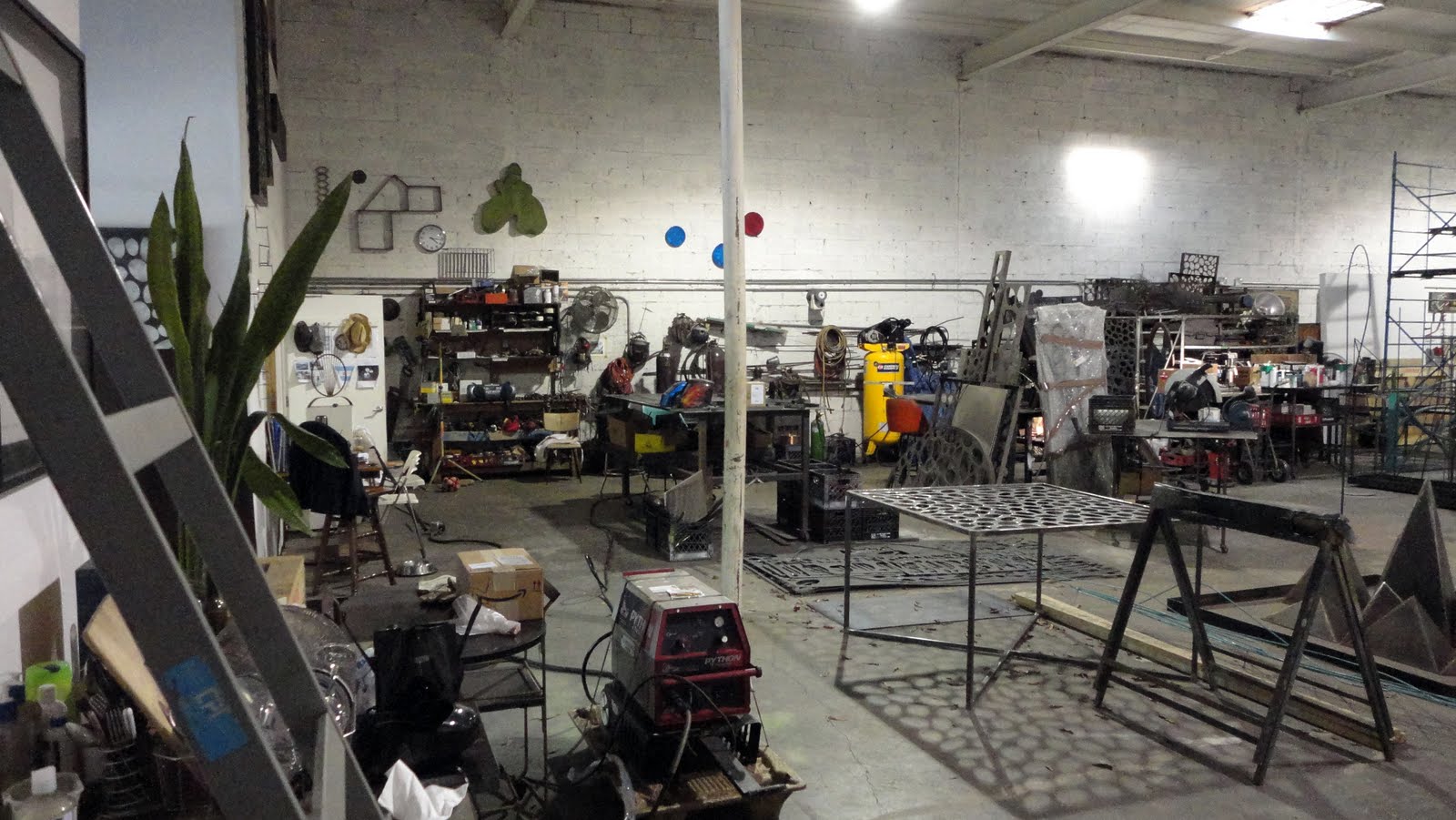
I love to visit artists studios.  They are all a bit different especially depending on the media the artist employs.  But there is also a similarity between most studios.  New works in progress on walls or on tables.  Older completed works stored in bins, or in crates, or leaning up against walls.  New completed works hanging on walls or standing in space in mock gallery settings.  Organized chaos.
Rusty and I went with Janda Wetherington, director of PanAmerican ArtProjects, to visit Carolina Sardi in her Miami studio.
Rusty, Carolina, Janda

Sardi was born and raised in Argentina.  She earned her MFA in Sculpture at National University of La Plata, where she also studied Architecture with the artist Enio Iommi.  She has been living and working in Miami since 1995.  I first encountered her work at PanAmerican ArtProjects when they had a gallery in Dallas.  I have seen Sardi's work at art fairs around the world with several galleries.


Sardi is quite expressive as she speaks about her ideas and process.  Her studio is in the Little Haiti neighborhood of Miami in a building originally owned by Bernice Steinbaum.  The space looked to be about 4000 sq ft with a 15 ft ceiling.  Large. And well adapted for the work of a metal sculptor.


Sardi's 2006 artist statement tells us:
"My art it's my way to express my world vision. I try to convey the maximum of information in the most minimal but essential forms .The concept is as important as the image and the space as important as the shapes. What appears as simple at first glance, becomes upon closer registration much more intricate . The interaction with the spectator brings forth multiple personal interpretations.

Material source for my art comes from various places including everyday life and my own personal experiences . Each form is a symbol that can stand alone, signifying one idea. Together, they can grouped and arranged in an installation that will represent a new or more complex idea and will enhance the central theme. Although I work mainly with steel, my pieces have an organic sensibility that reflects my interest in the basic interactions of life.

My latest wall installations are created by a combination of oval or round painted steel pieces arranged over an invisible grit .The egg shapes are placed in an structured but organic composition that creates a visual effect of mathematical repetition in the space . Each element of the whole is different, they keep their individuality and they maintain their particular presence inside the totality . The embryonic forms can be seen as particles or entities of what it will be. The white stark wall become the background or the medium in which this atmospheric landscapes are created . The steel pieces are placed against the wall , but separated from its surface with a distance of one or two inches, creating a floating effect in the space that is enhance by lights and shadows .The color reinforces the concept of each composition , in which eggs , circles or particles are a symbol of infinity and origin and can become anything and everything when changing color , shape and placement in the space; allowing new compositions , subjects and messages."

I see this evident in these sculptures in her studio:


The Miami Art Guide had this to say about Sardi's work presented in the Spring of 2010 at PanAmerican ArtProjects:
"Carolina Sardi’s wall installations are poetic equations that dissect the artist’s world. Titling many of her pieces “Associations” Sardi makes precise use of formal artistic elements that resonate beyond aestheticism. As the artist best explains, “Although I work mainly with steel, my pieces have an organic sensibility that reflects my interest in the basic interactions of life.” Sardi’s latest series titled “Constellations” delicately trace celestial paths. The sophisticated Calder-like sculptures are a departure from her previous series of colorful free-flowing installations. Even though these works are made of single pieces rather than individually installed shapes, they possess the speed, and sleek mobility of shooting stars."

 the yellow sculpture on the right above is part of Sardi's Home Cell series


Here is one of the Constellation pieces
PanAmerican used an image of this piece for their 2010 Happy Holiday card


My favorites are these that are sculpted from stainless steel and have been plated in gold, silver and bronze

 the ones above were in styrofoam preparing to be shipped


the one above was in the gallery in Miami, but I see that it is now sold.  

After an excellent visit, we headed out.


Sardi's work is currently on exhibition through July 23 at Galerie Lelia Mordoch in Paris, France and at Cheryl Hazan Gallery in New York, NY through September 3.

In addition to PanAmerican ArtProjects in Miami, Florida,  Sardi is also represented by Swenson Fine Art in Laguna Beach, California.


Sunday, July 3, 2011

33 Bond Gallery @ SCOPE Miami 2007 "Unscrew and View"


This has always been one of my favorite photos that Rusty has taken at an art fair.  I enjoy the odd relationship created by one of the Kate Clark sculptures staring directly into Rusty's camera while the male gallery director of 33 Bond Gallery is also staring directly at Rusty.  The other two, the other sculpture and the other gallery director, are focused on other things.  It was an odd experience to be roaming around the art fair tent while the galleries are all just setting up their booths in preparation for the next day's grand opening.  On the one hand, I got the most fabulous experience of being able to see much of the art just as it is being un-crated. On the other hand, I felt rather in the way. But it was all necessary preparation for the next day's business.   Now, I love being able to examine these moments in time and research from this source.  Notice the collage on the wall between the two gallerists.  That is a piece by artist Jason Roskey who was born in Ft Worth and earned his art degree at Texas Tech University in Lubbock.  I didn't find a website for him, so the link goes to a recent interview he had with NYArts.  I enjoyed reading Jason's summation of the Dallas art scene.


This Korean born artist is also represented by 33 Bond Gallery.  I've liked all of his sculptures that I have seen over the years. 


Monday, June 27, 2011

Interview with Ricardo Paniagua

I met up with Ricardo Paniagua at his studio in Dallas at the Continental Gin Building in the Deep Ellum neighborhood.  From there, we walked over to Murray Street Coffee Shop for the interview.
I had the most wonderful chocolate and rose petal black tea as well as a grand view of the Giles Lyon painting seen behind Paniagua in the photo above.  We spoke at length about art and spirituality, two subjects in which Paniagua demonstrated surprising erudition. He didn't want me to take pictures of work in progress in his studio.  I totally understand this since my full-time artist partner does not want me to look at him working until he is ready for me to see the end of the day's progress.  Paniagua's craftsmanship is superb, though, I must say.  His stretcher frames are square and plum and large, most as tall as me.  His 3D sculptures are sanded to perfection.  Here are a four pictures I took in his studio earlier this year at an Open Studio event:
Here are two photos of recent 3D sculptures Paniagua has created.

photos by Kipp Lott used with permission from Ricardo Paniagua
And now for our interview:

HC:  So here’s one question, and you can answer how ever you want to of course.  Is Paniagua your actual last name?
RP:  No, it’s an adopted middle name. It’s my great grandfather’s, he emigrated from Portugal to Houston, and shit, that was his name.
HC: I mean, it fits a “starving artist”, sort of, you know what I mean?
RP: well, um, you know, I’m a deep thinker, and uh…
HC: Sure
RP: well, you know, the other day Kevin Obregon came over and he was leaving, and I had just bought some really nice organic fruit, and I said “hey, Kevin come here” and I gave him some fruit, and I said “this is the best part of real life that, you know, physical life that we can know”.  It gets back into blood.  A lot of suffering happened for us to be here right now.
HC: Sure, yeah
RP: lot of suffering….And if it weren’t for the semen in my grandfather’s penis, I wouldn’t be here. And all his hardships.  But that name, as you know, means ‘bread and water’
HC: Sure
RP:  And to me that’s a very spiritual concept
HC: Yeah
RP:  And since I was a little kid, I’ve always had dreams, and I’ve always been spoken to. And, you know, that’s a very spiritual thing to happen to somebody.  Somebody who doesn’t even know who God is.  So it’s that kinda coincidence that that name is, well my grandmother uses it, my dad uses it….I didn’t find it a coincidence that that blood is who I was. I even wrote it in grade school, because, you know, I am a lot more spiritual than a lot of people, and that name is no coincidence, you know.  So that’s why I’ve adopted that name kinda as my middle name.  My full name is Ricardo, then I say Paniagua, then Garcia and then The Third.  I’m a Third as well.  It can get pretty long, I guess, if you want to be proper about it.
HC: Yeah.  I knew your last name is Garcia because I’d seen it on the mail slots when I came for a Continental Gin Studio Tour, so I just wondered about it.
RP:  Yeah, when I started getting into shows and stuff, I was submitting my whole name, because that’s what I wanted. Then it became just too much of a hassle for art organizations, for the PR departments, you know, for the news media.  You need to have something simple, you know?
HC: You do, you do. And something that stands out and is different from everybody else’s name.
RP:  That too.
(He also told me when the recorder was off that he had been in a show at the Dallas Latino Cultural Center and he had used his full name.  But the curator of the exhibition shortened it to "Ricardo Paniagua" in the media and he has used it ever since.)

photos by Kipp Lott used with permission from Ricardo Paniagua

HC: How did you become inspired to become a painter?
RP:  Oh you know what dude….well in elementary school…well we’d oftentimes be put into groups, one of us would have to do the art, an’ one of us would have to do the edit, you know all the different stuff.  I would always do the art, and I remember I would really make some badass drawings, and I ‘d say "I’m the artiste" and all this shit….even my mother said that I was doing some pretty crazy shit at two or three years old.
HC: Cool
RP: Anyway that’s what she said.  But I was growing up an’ I never wanted to be an artist, you know, because somebody told me that artist have drug problems and cut their ears off.  And I didn’t want to be crazy.  I didn’t want to be known…
HC: Then don’t eat the paint, OK?
RP:  ...so I never wanted to <be crazy>.  I was goin’ to church, and, I don’t know, I went to church one day and picked up a book, this was when I was in my late teens or early twenties, it was called “A Tree Full of Angels”.  A friend has it right now.    And I said, well, if that’s the case then I’ll go ahead and accept myself as an artist. If I have to do whatever I have to do to maintain my own integrity in the world, then I’ll do it.  So that’s when I accepted, but I’ve always been creative. I’ve always been artsy-fartsy.
(We both laughed at his flippant reference.)

photos by Kipp Lott used with permission from Ricardo Paniagua

HC: Are there any artists that inform your work, or that you hold up as Art Gods?  I use ‘Art God’ because I know that has been a title of one of your art shows.
RP: (chuckles) I like that
HC: who are your Art Gods?
RP:  I like Antonio Gaudy. I like Julian Schnabel. Nicholas Roerich. As far as visual artists go.  Heironymus Bosch – all time great, favorite. William Bouguereau is really high up on my list.  And I also like Valasquez, he was a real spiritual guy in life.

photos by Kipp Lott used with permission from Ricardo Paniagua

HC: Have you seen any recent museum exhibits that have stuck in your mind, or made you think?
RP: Well on line, I’ve seen pictures of “Art in the Streets” at MOCA. (chuckles then continues, smiling) And I don’t care for it one bit, but it stuck in my mind.
HC: Why do you not care for it?
RP: Because I think street art is too confined.  You know, why does street art have to be graffiti?  Why does it have to be with spray paint?  You know, and all this different stuff.  And that’s one thing I’m trying to do.  Well that’s actually…I’m going to be doing this show in San Antonio at ArtPace and the Guadalupe Center that deals with the issues I have with the term ‘street art’.  The Brooklyn Museum wouldn’t let that show travel there, well they said it was financial, but I don’t think it’s right to be showing all these little kids that it is cool to, you know, vandalize all these people’s personal property.
HC: I’m sure property owners will agree with you!
RP: yeah….But I did just find out that, I think in 2012, I think the MOCA agreed to give JulianSchnabel a retrospective - which is pretty insane.  Some people think Julian Schnabel is the most overlooked artist of his time…I couldn’t agree more. I mean, I would put Schnabel’s work up there with, I don’t know if Schnabel would agree, but I like his work better than Picasso.  That would be the only other museum show that I’d be concerned with, even though it hasn’t even happened yet….I just love all of his paintings, I mean they’re just awesome.  But I heard he didn’t take a bath, I heard people say that he stinks. (laughs) oh, which I’m sure is true for me sometimes too (laughs)
(We both laugh)
HC: Well, you know, you get in your own world, and that is why people think artists are crazy, right?

photos by Kipp Lott used with permission from Ricardo Paniagua

HC: So what’s a normal day like for you? Do you work seven days a week?
RP: yeah, I work too much dude.  Like yesterday I got up at 8:30 (am) and I worked on my sculptures until I went to bed at 1:30 (am), and I went to lunch, and I went to the hardware store to get my materials, and I just, like, worked all day and did facebook all day (chuckles). So like yeah, my computer is in my studio, and when I get tired of working I’ll go get on facebook, and then when I get bored on facebook I go back to working. Then I’ll just do that same thing all day.

We walked back to his studio where I had left my truck.  As I drove through Deep Ellum, I stopped and took these two pictures of wall murals Paniagua was commissioned to paint a few years back.

This painting is currently for sale at the Ro2 Art gallery in Dallas

The paintings shown in between the interview text above (photos by Kipp Lott) will be featured in juried group exhibitions this summer at Galleri Urbane Marfa/Dallas starting July 9, and Guadalupe Cultural Arts Center in San Antonio starting July 14.  Paniagua's exhibition at The Museumof Geometric and MADI Art continues through July 10.

To close, here are a few of my pictures from the opening reception at The Museum of Geometric and MADI Art:


Saturday, June 25, 2011

Tuesday, June 21, 2011

Magdalena Abakanowicz @ The Margulies Collection Revisited

This past January was my second time to visit The Margulies Collection at the Warehouse in Miami.  Magdalena Abakanowicz's sculptures are hauntingly beautiful themselves.  Her accompanying text sends shivers up my spine.

Hurma (Crowd), 1994 - 1995
Group of 250 figures (children and adults)
Burlap and resin

Magdalena Abakanowicz
About Hurma (Crowd)
It happend to me to live in times, which were extraordinary by their various forms of collective hate and collective adulation.  Marches and parade worshipped leaders, great and good who soon turned out to be mass murderers.  I was obsessed by the image of the crowd, manipulated like a brainless organism and acting like a brainless organism.  I suspected that under the human skull, instincts and emotions overpower the intellect without us being aware of it.

It was my ambition to speak in metamorphic language of my sculpture, about my experiences.  I wanted to warn, to provoke thinking to show to people all over the world the existential fears common to all of us, the doubts about ourselves, that we all suffer and the fears of crowds carrying the instinct of destruction of themselves and the surrounds.
Magdalena Abakanowicz, 1992

This text was also posted on the wall to accompany the text above: